



US citizens do not need to visit a Saudi consulate to perform Umrah. As of 2026, most American Muslims travel on the Saudi tourist eVisa, a multiple-entry visa that also covers Umrah outside the Hajj season, while a smaller number still apply through a licensed agency for a traditional Umrah visa. Understanding the Umrah visa requirements for US citizens before you start the application saves weeks of frustration, since one missing document, an expiring passport, or an unverified hotel booking can delay an entire trip. This guide walks through eligibility, the documents Saudi Arabia asks for, the two visa routes available to Americans, real costs in dollars, processing timelines, and the mistakes that most often trip up first-time pilgrims from the United States.
Umrah Visa Basics for American Pilgrims
Umrah is the lesser pilgrimage to Makkah and Madinah, and unlike Hajj, it can be performed at almost any point in the year. A visa gives a traveler legal permission to enter Saudi Arabia for that purpose, and for US passport holders, the process has become considerably easier over the past several years.
Saudi Arabia’s Ministry of Hajj and Umrah now manages bookings and permits through Nusuk, a government platform that links flights, hotel confirmations, and Umrah slots together. Every pilgrim, regardless of which visa they hold, ultimately needs a Nusuk-registered Umrah permit to enter the Grand Mosque, so the visa is really the first of two steps rather than the entire process.
For American travelers who remember older accounts of the process, the shift is significant. A decade ago, Umrah for US citizens almost always ran through a licensed agency, with limited transparency around pricing and timelines. The introduction of the tourist eVisa changed that by giving Americans a direct, government-run application path, while Nusuk added a layer of coordination that keeps hotel capacity and mosque access manageable during peak travel periods.
Are US Citizens Eligible for an Umrah Visa
Yes, US citizens are eligible to perform Umrah in 2026, and eligibility is not tied to nationality beyond routine passport and health requirements.
Saudi Arabia includes the United States among the passport holders eligible for the Saudi tourist eVisa, which means most Americans can apply entirely online without going through a travel agency first. The only real restriction is timing: new Umrah visas and Umrah bookings pause during the weeks immediately before and during Hajj, when Mecca is reserved for Hajj pilgrims holding a dedicated Hajj permit. Outside that window, which typically falls in the spring, US citizens can travel for Umrah at any time of year.
Two Ways US Citizens Can Perform Umrah
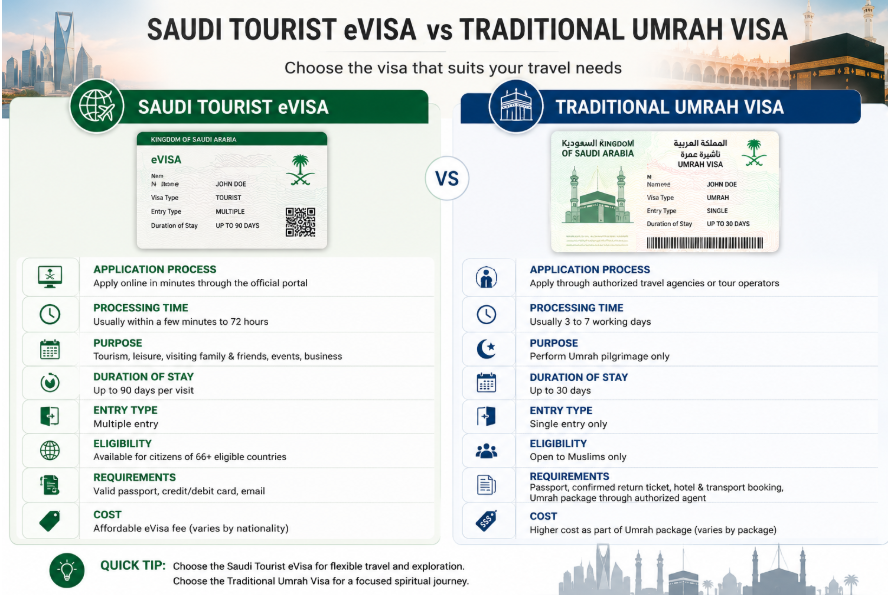
American pilgrims have two realistic paths into Saudi Arabia for Umrah, and picking the right one depends on how much flexibility and structure you want.
The Saudi Tourist eVisa
This is now the default route for most US citizens. It is a multiple-entry visa valid for one year, allowing stays of up to 90 days per visit, and it can be used for tourism, family visits, and Umrah outside the Hajj season. Applications go through the official government portal, visa.visitsaudi.com, and approval is usually issued within a day. Because the tourist eVisa is not tied to any specific travel agency, pilgrims can book their own flights and hotels, though a Nusuk-verified Umrah permit is still required once inside the country.
The Traditional Umrah Visa
Some pilgrims still prefer, or are required by their travel plans, to apply through a licensed Umrah agency in the United States. This route bundles the visa application with a full package covering hotels, transportation, and a group leader, and it remains common among first-time travelers who want a more guided experience. The tradeoff is less flexibility and a dependency on the agency’s timeline, though the documentation requirements are broadly similar to the eVisa route.
| Feature | Saudi Tourist eVisa | Traditional Umrah Visa |
|---|---|---|
| Application method | Online, self-service | Through a licensed agency |
| Validity | 1 year, multiple entry | Tied to the booked package dates |
| Stay length | Up to 90 days per visit | Length of the booked package |
| Approval time | 24 to 72 hours | 5 to 10 working days |
| Booking flexibility | Choose your own flights and hotels | Hotels and transport arranged by the agency |
| Best for | Independent travelers, repeat visitors | First-time pilgrims who want full guidance |
Umrah Visa Requirements for US Citizens: Documents Checklist
Regardless of which route you choose, Saudi Arabia expects a consistent set of documents before issuing a visa. Gathering these ahead of time is the single best way to avoid delays.
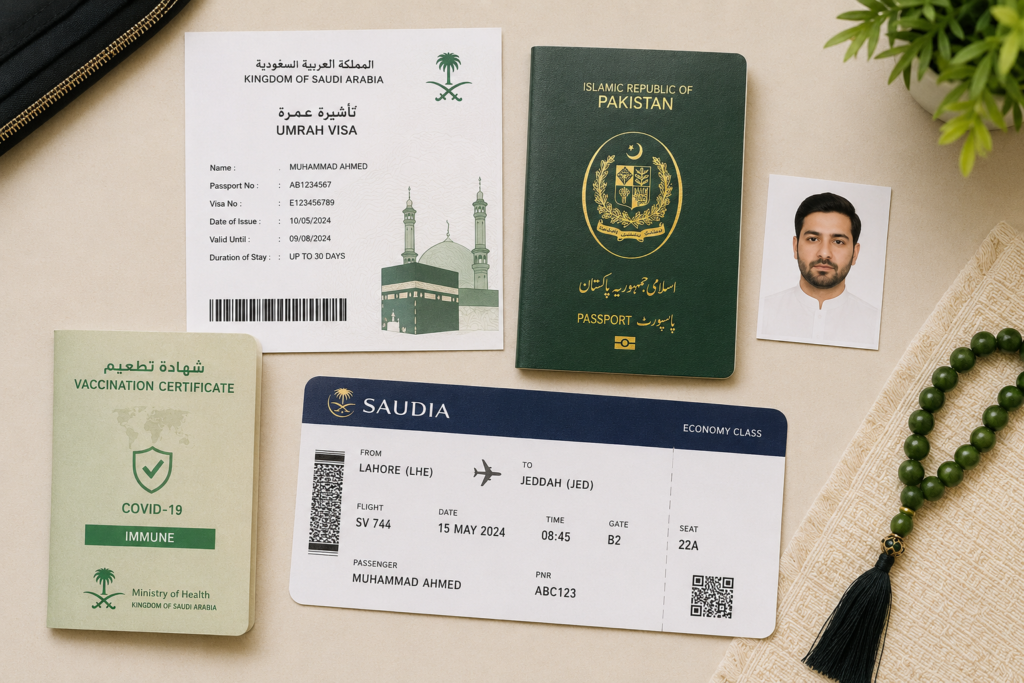
- A US passport valid for at least six months beyond your planned entry date, with at least one blank page
- A completed visa application, either through the eVisa portal or provided by your Umrah agency
- A recent passport-style photo with a plain white or light background
- Proof of a confirmed round-trip flight
- Proof of accommodation in Makkah and Madinah, now required to be linked through Nusuk
- A meningitis vaccine (ACWY) certificate, administered at least ten days before arrival
- For converts to Islam, a letter from a mosque or Islamic center confirming their faith
- For women traveling alone, no male guardian is required to register for or perform Umrah
The Meningitis Vaccine Requirement
The meningitis vaccine (ACWY) is the one health requirement that catches travelers off guard most often. Saudi Arabia requires proof of vaccination for all pilgrims, and the shot needs to be given at least ten days before arrival for it to be considered valid at the border. Most US pharmacies and travel clinics carry the ACWY vaccine, but availability and cost vary, so this is worth scheduling as soon as travel dates are set rather than the week before departure.
How to Apply for an Umrah Visa from the USA
For pilgrims using the Saudi tourist eVisa, the process for Umrah Visa Requirements for US citizens is short enough to complete in one sitting.
- Go to the official Saudi eVisa portal at visa.visitsaudi.com and create an account with an active email and phone number.
- Select tourism as the purpose of travel, since Umrah falls under this category outside the Hajj season.
- Enter passport details and travel dates exactly as they appear on your passport, then upload a digital photo.
- Pay the visa fee online by credit or debit card.
- Once approved, download the eVisa as a PDF and keep both a printed and a digital copy.
- Register separately on Nusuk to book your Umrah permit, hotel confirmation, and entry time slot at the Grand Mosque.
Pilgrims applying through a licensed agency follow a similar sequence, except the agency collects documents, submits the application on the traveler’s behalf, and confirms the Nusuk booking as part of the package.
Umrah Visa Cost for US Citizens in 2026
Pricing depends entirely on which route is used and whether extra services are purchased.
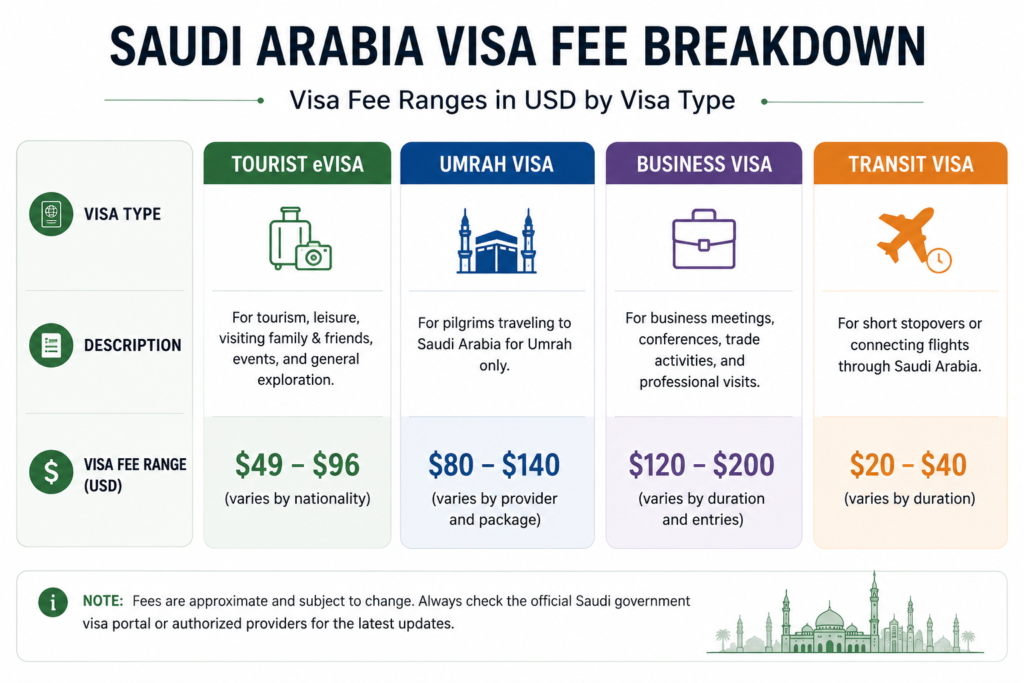
| Visa Type | Government Fee | Approx. Total Cost (USD) |
|---|---|---|
| Tourist eVisa (online) | SAR 535 includes insurance | Around $140 to $145 |
| Tourist eVisa (on arrival) | SAR 480 | Around $128 |
| Traditional Umrah visa | SAR 300 plus SAR 100 to 180 insurance | Around $107 to $128 |
| Full Umrah package via agency | Varies by package | Typically $390 and up per person |
Third-party websites often charge $180 to $250 for a visa that costs closer to $140 through the official portal, so it is worth applying directly whenever possible, or using a licensed agency that discloses its service fee clearly.
Umrah Visa Requirements for US Citizens and its Processing Time
The Umrah visa processing time varies by route. Tourist eVisa applications are usually approved within 24 to 72 hours, and some travelers see approval within a few hours during off-peak periods. Traditional Umrah visas processed through an agency typically take five to ten working days, since the agency needs to verify documents before submission. Processing slows noticeably during Ramadan and in the weeks right after Hajj, when demand spikes across both visa types, so applying four to six weeks before travel gives enough buffer for corrections if something is rejected.
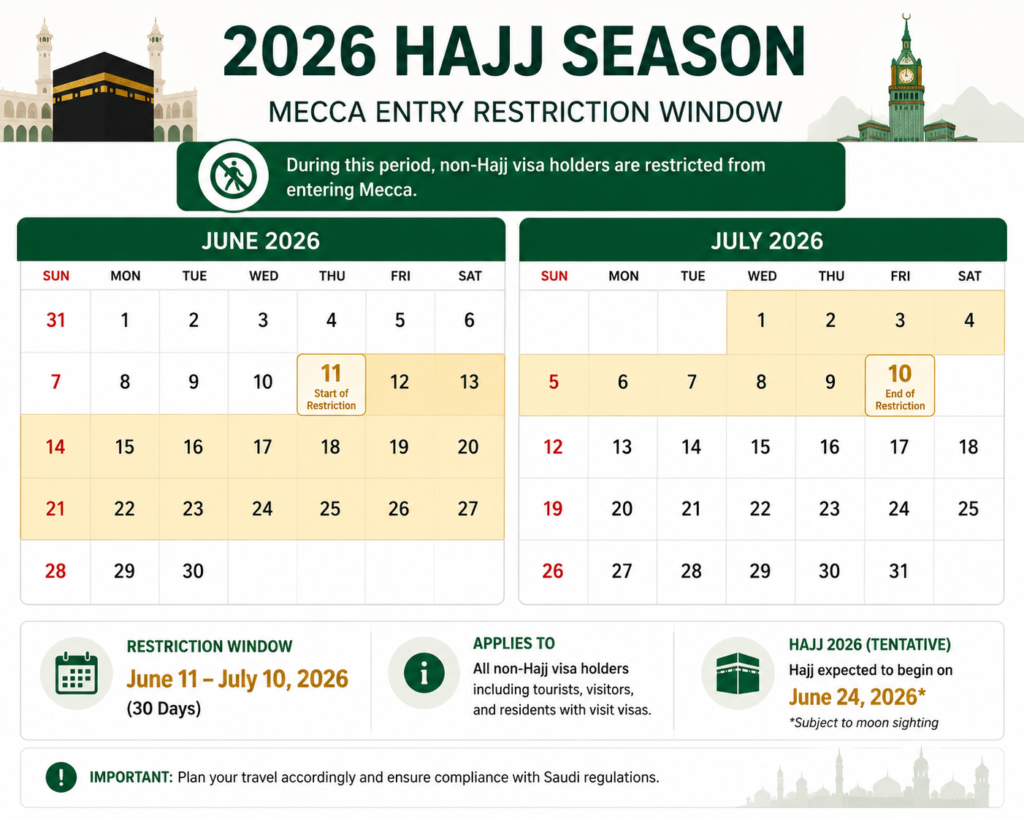
Hajj Season Restrictions and Mecca Entry Rules
This is where many first-time American pilgrims run into trouble, since the restriction is easy to miss when booking travel far in advance.
Tourist eVisa and Umrah visa holders are barred from entering Mecca during the Hajj season restrictions window, which in 2026 runs from roughly mid-April through early June. Entering the city during this window without a dedicated Hajj permit is enforced through checkpoints, and violations can carry fines in the range of SAR 10,000 to 20,000, along with deportation and a multi-year re-entry ban. Outside this window, Umrah is open year-round, and the most comfortable months to travel tend to be October through March, when temperatures in Makkah are milder and the crowds are smaller than during Ramadan.
Traveling as a Family or Group
Families and small groups make up a large share of US-based Umrah travelers, and the visa requirements for children and spouses follow the same core rules as for individual adults, with a few practical differences worth planning around.
Children traveling with a parent need their own valid US passport and their own visa or eVisa application, since minors cannot be added to an adult’s passport for Saudi entry purposes. A copy of the child’s birth certificate is commonly requested to confirm the family relationship, particularly when applying through a licensed agency rather than the self-service eVisa portal. Married couples are sometimes asked for a copy of their marriage certificate as well, mainly when booking shared hotel rooms through Nusuk.
Group departures organized through a travel agency simplify much of this, since the agency typically handles Nusuk registration, room assignments, and document verification for the entire group at once. Families applying independently through the tourist eVisa should budget slightly more time per traveler, since each application, photo, and payment is processed separately even when submitted on the same day. Families who prefer a more personal, closely guided experience often look into special group Umrah packages instead of large group departures.
Common Mistakes US Citizens Make When Applying
A few patterns show up again and again among American pilgrims who run into delays.
Applying with a passport that expires within six months of the travel date is the most frequent cause of rejection, since Saudi immigration checks this automatically. Booking a hotel that is not linked through Nusuk is a newer problem, since 2026 rules tie every Umrah visa to a verified accommodation and transport booking rather than allowing pilgrims to book separately after arrival.
Skipping the meningitis vaccine until the last minute is another common issue, since the ten-day window before travel is a hard requirement rather than a suggestion. Finally, using unofficial visa agents who promise faster approval for a premium fee often introduces spelling errors or invalid hotel confirmations that cause more delay than they save.
A less obvious mistake is assuming the tourist eVisa and the Umrah visa carry identical rules simply because both permit Umrah. The two differ in validity length, stay duration, and how they interact with Nusuk booking requirements, so mixing up details from one route while applying through the other is a common source of confusion, especially for travelers researching across multiple websites that do not clearly separate the two.
After Approval: Registering on Nusuk
Getting the visa approved is not the final step. Every pilgrim, whether on a tourist eVisa or a traditional Umrah visa, still needs to register on Nusuk to book an entry time slot for the Grand Mosque, confirm hotel details, and in many cases, reserve a visit to the Rawdah in Madinah. This step is separate from the visa application itself and is easy to overlook, especially for travelers used to older systems where a visa alone was sufficient. Building in a few days after visa approval to complete Nusuk registration keeps the rest of the trip on schedule.
Conclusion
Meeting the Umrah visa requirements for US citizens comes down to a handful of details done correctly: a passport with enough validity, the meningitis vaccine completed on time, a Nusuk-linked hotel booking, and an application submitted through the official portal or a licensed agency rather than an unofficial reseller. Most American pilgrims now find the Saudi tourist eVisa the simplest route, though a full package through a trusted agency remains a strong option for anyone who prefers a guided experience from arrival to departure. Whichever path you choose, applying four to six weeks ahead of your intended travel date gives enough room to fix small errors before they become bigger problems and turns the paperwork into a formality rather than a source of stress.
If you are ready to start planning, Majmua Travels can help match the right visa route to your travel dates and guide you through every step from application to Nusuk registration.
Frequently Asked Questions
Do US citizens need a separate Umrah visa, or can they use the tourist eVisa?
Most US citizens can use the Saudi tourist eVisa for Umrah, since it covers tourism, family visits, and Umrah outside the Hajj season in one visa. A dedicated Umrah visa through a licensed agency is still available for pilgrims who prefer a fully guided package.
How far in advance should US citizens apply for an Umrah visa?
Applying four to six weeks before travel gives enough time to fix passport or document issues, complete the meningitis vaccine, and finalize a Nusuk-linked hotel booking. Add extra time during Ramadan or shortly after Hajj, when demand is higher.
Is the meningitis vaccine really mandatory for Umrah?
Yes, the ACWY meningitis vaccine is mandatory, not optional, and must be given at least ten days before arrival to be valid. Saudi authorities can deny entry without proof of vaccination, and it is one of the important Umrah Visa Requirements for US Citizens.
Can US citizens travel to Mecca during Hajj season on an Umrah visa?
No, tourist eVisas and Umrah visas do not permit entry to Mecca during the Hajj season, which is enforced through checkpoints. Only a dedicated Hajj permit issued through Nusuk allows entry during that window.
How much should US citizens budget for an Umrah visa in 2026?
The government visa fee runs roughly $107 to $145, depending on the route, with the Saudi tourist eVisa at the higher end since it includes insurance. Full Umrah packages from the USA that bundle flights, hotels, and transport typically start around $390 per person.