



The Kaaba also known as Khana Kaaba or the Holy Kaaba is the most sacred site in Islam. While millions of Muslims circle around it during Hajj and Umrah, very few ever see what lies inside Kaba. In this in-depth guide, we explore the architecture, spiritual significance, physical contents, access policies, and history of the Kaaba’s interior along with richly detailed sections to satisfy curiosity and support SEO ranking.
Whether you are a pilgrim preparing for Hajj or Umrah, a student of Islamic history, or simply curious about the inside view of the Kaaba, this article covers everything from what’s physically inside to why so many are keen to glimpse it.
Table of Contents
- What is Inside Kaba?
- Architecture and Dimensions
- The Interior Today
- The Marble Floor
- Supporting Wooden Pillars
- Hanging Lamps and Incense Burners
- Inscribed Marble Plaques
- Markers of Prayer and Devotion
- Internal Door: Bab al-Tawbah
- Storage Chest and Perfumes
- Spiritual Significance of the Interior
- How the Kaaba is Washed and Cleaned
- Who Gets to Enter the Kaaba?
- Common Misconceptions About ‘What’s Inside the Kaaba’
- Visualization, Pictures, and Inside Kaaba 360 ° Views
- Table: At a Glance Key Elements Inside the Kaaba
- How Majmua Can Help Your Spiritual Journey
- FAQs — Quick Answers About Inside the Kaaba
What is Inside Kaaba?
Kaaba is a cubic building in Arabic meaning cube, which is a cube found in the central of Masjid al-Haram in Mecca, Saudi Arabia. It is believed to be the House of Allah (Beytullah) and is used as the Qibla which all Muslims pray facing the world.
The Kaaba is draped in black cloth known as the Kiswah on the outside, but on the inside; only a few people get to see the interior, which is preserved, honored and knotted centuries of the Islamic tradition.
Architecture and Dimensions and Significance of Black Stone (Hajar al-Aswad).
The Kaaba is a cuboid building, approximately 15 m tall and sides 10 m x 12 m. Its walls and floors were renewed throughout history and in its interior architecture all the layers of historical attention can be seen.
The inside view of khana kaba is plain unlike the exterior which is crowded with people and the rituals done therein on a daily basis. Also the khana kaba inside images surface on the internet from several countries visitors sharing their experiences.
The black stone inside the kaba or the Al-Hajar al-Aswad is one of the most sanctified objects in the Islamic religion, and it is embedded in the eastern corner of the Kaaba located at the Makkah Masjid al-Haram. It is a significant part of the tawaf worship, and it has a strong religious and historical meaning to the Muslims in the world.
Origins and Tradition
The Islamic tradition states that the Black Stone was dropped down to Paradise (Jannah) and initially it was whiter than milk, however, with age it became darker because of being in contact with faithful people and, symbolically, the sins of humanity. In some narrations, it is said that it was handed over to Prophet Ibrahim (Abraham) and Prophet Ismail (Ishmael) when they erected the Kaaba and it came to its present location upon building.
The legends of the stone are pre-Islamic and it was worshiped even before Islam, yet, the stone has been fractured in several pieces, which have been joined now with a silver frame to the wall of Kaaba.
Ritual Role in Hajj and Umrah
During tawaf the act of circling the Kaaba seven times pilgrims aim to touch or gesture towards the Black Stone at the start and end of each circuit. This act is performed in emulation of the Prophet Muhammad ﷺ, who kissed the stone during his lifetime. Even when physical contact isn’t possible due to crowds, pilgrims will point toward it with their right hand while saying “Allāhu Akbar.” It is important to note that the act honors the Prophetic tradition, and worship is directed to Allah alone.
Spiritual Meanings and Symbolism
The Black Stone carries several layers of symbolic significance:
- Sign of Unity and Tradition: The fact that Kaaba has it connects the history of millennia of monotheistic worship and the heritage of the Prophets.
- Recollection of the Flaws of Humanity: The fact that the rock turned dark with time is regarded as a commentary piece on how humanity failed, furthering the ideas of the need to repent and the need to be selfless.
- Unity of the Ummah: The unity of Muslims around the world that is evident in the presence of millions of Muslims visiting Mecca despite having varied backgrounds reflects the unity of the world Muslim community with a common set of beliefs and practices.
Although the Black Stone is sacred, Islamic tradition underlines that the Black Rock does not possess any divine power in which it is revered as a part of prophetic tradition and historical continuity, but not as a god.
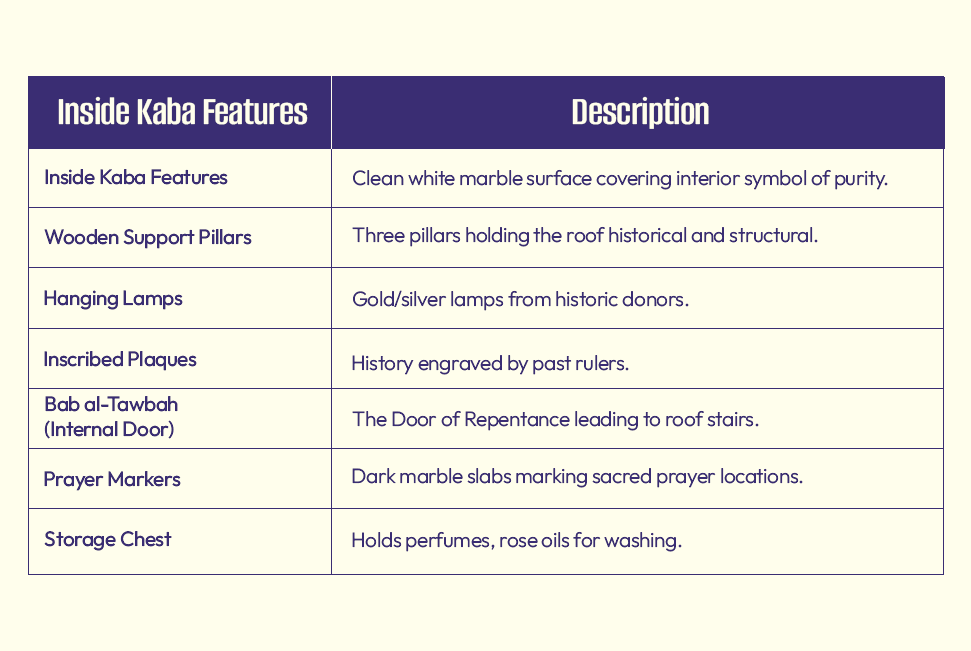
What is inside khana Kaba at a Glance — Key Elements
The Interior Today Inside Kaba: Detailed Description
The Marble Floor
The entire interior floor is covered with marble predominantly white with some decorative elements creating a clean, sacred surface for those rare occasions when the space is entered.
Supporting Wooden Pillars
Inside, three wooden pillars support the roof. These pillars were installed by early caretakers and are said to be original and over a thousand years old.
Hanging Lamps and Incense Burners
Numerous gold and silver lamps or incense burners hang from the ceiling gifts from rulers throughout Islamic history. Why there are so many pots inside kaba? They are often mistakenly referred to as pots or containers, but they are symbolic adornments and part of the space’s sacred decoration.
Inscribed Marble Plaques
Marble plaques with inscriptions commemorate renovations carried out over centuries, from early Muslim rulers to modern Saudi expansions. The plaques are embedded on the interior walls and record the historical evolution of the Kaaba’s care.
Markers of Prayer and Devotion
Certain dark marble slabs mark areas where Prophet Muhammad ﷺ prayed and supplicated inside the Kaaba during early Islamic history making them revered spots within the interior.
Internal Door: Bab al-Tawbah
To the right of the interior wall is the internal door, Bab al-Tawbah (Door of Repentance), which leads to a staircase up to the roof. This door bears its own silk covering and holds spiritual significance as a passage of mercy.
Storage Chest and Perfumes
There is also a large marble storage chest used to hold perfumes and rose water for the annual washing and purification ritual. These scents are part of the cleansing that honors the sanctity of the Kaaba.
Spiritual Significance of the Interior of Inside Kaba
While the exterior of the Kaaba is central to Islamic rituals like Tawaf (circumambulation), the interior holds spiritual symbolism:
- Unity of worship and simplicity
- Presence of historical markers tied to Prophet Ibrahim (Abraham) and Prophet Muhammad ﷺ
- Remembrance of monotheism
The khana kaba inside interior devoid of idols reflects Islam’s emphasis on unity with Allah alone. It is a place of silent presence, not public worship.
How the inside of Kaba is Washed and Cleaned
Twice a year, the Kaaba’s interior is ritually washed in a formal ceremony:
- The Custodian of the Two Holy Mosques and high officials participate.
- The Kaaba is cleaned with Zamzam water, rose water, and oud oil.
- This act symbolizes purification, renewal, and devotion.
These rituals are among the few times the interior is open and witnessed by invited guests. Also you can read our complete guide for first time umrah pilgrims here.
Who Gets to Enter Inside Kaba? Access, Restrictions & Custodianship
While millions of Muslims perform tawaf (circling the Kaaba) during Hajj and Umrah, the interior of the Kaaba itself is rarely opened, and ordinary pilgrims are not permitted inside. Entry into the sacred chamber is considered a great honour and is highly restricted.
Access Is Not Open to the Public
- The general public including most pilgrims cannot enter the Kaaba. Its door remains closed for most of the year and is only opened under rare official circumstances.
- Since the Kaaba stands within the Masjid al-Haram, only Muslims may even enter the city of Makkah and its sacred precincts, but that does not guarantee interior access to the Kaaba.
Are people allowed inside kaba?
Only a very small number of people are allowed to enter, and only under certain occasions like an instance of the ceremonial cleaning of the Kaaba:
1. Custodians and Key-Holders
The Bani Shaiba (Banu Shaybah) tribe has been entrusted the keys to Kaaba since the pre-Islamic times and even today, the tribe still has the responsibility of holding the keys.
E.g. It is not only the members of this tribe who have keys to open the door of the Kaaba but also take part in its clean up, repair, and formal openings.
2. Saudi Officials, Dignitaries
High ranking Saudi officials, and royal family members are allowed to enter the Kaaba during ceremonial events, particularly when Ghusl (washing) ceremony is being done, normally before Ramadan and during other designated periods.
3. Religion Scholars and Representatives
Prominent religious leaders, clergy, and Islamic executives can be invited as a part of formal groups or religious rituals for kaba inside view.
4. Special Guests
On very rare occasions, select guests invited by the Saudi government sometimes including prominent international figures may be granted this honour.
Why Is Access So Restricted Inside Kaba?
The Kaba from inside interior is treated as an extremely sacred space, not a public site. It is:
- A symbol of monotheism and spiritual unity reserved for worship and ritual purification, not general visitation.
- Under custodianship tied to tradition and Islamic law, with the Bani Shaiba historically responsible for opening and closing the door.
- Typically opened only twice a year for formal cleaning ceremonies where select honored individuals participate in the sacred rite.
Brief Note on Access and Muslim Visitors
It’s important to distinguish between entering Masjid al-Haram (the Grand Mosque) and entering inside of the Kaba.
✔ Any Muslim who performs Hajj or Umrah and follows entry regulations (including visa and local rules) may enter the Grand Mosque to pray or perform tawaf.
✘ However, stepping inside the Kaaba’s interior space is not permitted for ordinary pilgrims due to the restrictions above.
Common Misconceptions About ‘What’s Inside the Kaaba
Myth: The Black Stone is inside the Kaaba
Fact: The Black Stone (al-Ḥajar al-Aswad) is embedded on the eastern exterior wall not inside.
Myth: There are idols or ancient objects kaba pics inside
Fact: All idols were removed upon the conquest of Mecca by Prophet Muhammad ﷺ; the interior contains no idols today.
Visualization, Pictures, and Inside Kaaba 360° Views
While public photos and kaba inside videos are extremely rare (due to restricted access), some inside khana kaba pictures surface on social platforms and documentaries, showing inside khana kaba 360 view:
- The marble floor and interior walls
- Wooden pillars
- Hanging lamps
- The internal door and inscribed plaques
- 360° visual representations created digitally
Note: Access through trusted media is best for visualization since direct entry is not permitted for most people.
How Majmua Can Help Your Spiritual Journey
Are you planning Hajj or Umrah and want a comprehensive travel experience? Majmua offers:
- Custom itineraries & packages tailored to your needs
- Visa processing assistance
- Luxury accommodations near Haram
- Guided tours with historical insights
- 24/7 support throughout your journey
Visit our Hajj & Umrah Plans page to learn more and start your spiritual journey today!
Conclusion: Have the khana kaba inside 360 view experience
The inside of the Kaaba is as spiritually profound as it is physically simple a space that embodies humility, monotheism, and history. Its rarity and sanctity make it a subject of fascination for believers and scholars alike. With its marble floors, historic pillars, sacred inscriptions, and spiritual aura, the interior reflects the timeless devotion of the global Muslim community.
Understanding what lies within deepens respect for this central symbol of Islam and offers insight into one of the world’s most revered spaces. Check out the Premium Umrah Packages at Majmua.
FAQs — Quick Answers About Inside the Kaaba
1. Can you go inside the Kaaba?
No, you cannot, as a pilgrim, normally enter the Kaaba. The Kaba Sharif inside is not accessible to the population and it is highly restricted. During special events, very few dignitaries, custodians, and official guests are allowed in the occasion like a barring with cleaning ceremony or when a prominent guest is visiting. Common pilgrims attending Hajj or Umrah cannot access the interior space per se.
2. What would you have found in khana kaba inside view?
Had you been able to enter, you would find there a plain and holy room instead of a large hall. The interior contains:
- Lower walls and marble floor.
- The roof was supported by three pillars made of wood.
- The use of lantern-shaped objects and hanging lamps.
- The walls had marble plaques inscribed.
- A limited storage facility of oils and incense to be used in ceremony cleansing.
- It does not contain any idols, treasures or ritual objects, it is made an austere, pious chamber.
3. Does it have idols inside in Kaba?
No, idols are not there in the Kaaba just now. Prior to the era of Islam, several tribes used to erect idols inside Kaaba and around it, but they were eliminated by Prophet Muhammad ﷺ after Makkah returned to worship under the monotheistic doctrine. The interior is now idol free and this is in praise of the Islamic faith to Allah.
4. Does it have a video of the interior of the Kaba inside you can watch?
Yes, it has some isolated videos and photos on the web that reveal some of the interior of the Kaaba, but there are no official or publicly accessible 360-degree tours since the area is not accessible to regular people. These video clips are the only ones that have managed to show some of the marble floor, the columns and the lamps that are opened during special events in the interior.
5. What is the reason why there are lamps in the Kaaba?
Looking inside the Kaaba you will find lantern-like lamps by the ceiling. The kings, sultans, and leaders of history brought them as presents as a sign of respect and honour to the sacred space. When it is opened they are lit inside though they are not associated with any particular rite. Their existence is a symbol of historical homage and reverence, and not a religious need.